• Skip to main content

International Olive Council

The website of the International Olive Council

Logo du Conseil oléicole international
Linkedin icon Twitter icon
  • Santé
  • Alimentation
  • Durabilité
Marchés Subventions Postes Vacants Parrainage
Mail envelope Contact
Magnifier Recherche
Person icon Espace Privé
Person icon
Menu icon
MENUMENU
  • Qui sommes-nous
    • Mission et vision
    • Textes fondamentaux
    • Gouvernance et structure
    • Pays membres et observateurs
  • Nos Missions
    • Unité de Normalisation et Recherche
      • Normes, Méthodes et Guides COI
      • Groupes de Travail
      • Agrément aux Laboratoires et aux Jurys de Dégustateurs
      • Prix à la Qualité Mario Solinas
      • Soutien institutionnel du COI
      • Huile d’Olive, Nutrition et Santé
      • Recherche au Sein de l’Unité de Normalisationet Recherche
      • Base de données des documents du COI
    • Unité Oléiculture, Oléotechnie et Environnement
      • Technical Cooperation and Training
      • Olive Oil Technology and the Environment
      • IOC Scholarships
      • Supporting Member Countries
      • External Projects and Institutional Agreements
      • IOC Network of International Olive Germplasm Banks
      • Key Projects and Technical Resources
    • Unité d’Économie et de Promotion
      • Market Statistics
      • Country Profiles
      • Promotion Campaigns
      • Grants for Promotion Activities
      • Studies & Seminars
  • Press Room
    • Articles
    • Olive Health Information System
    • Monthly Olive Sector Statistics
    • Agenda 2026
    • Videos
    • Infographics
  • Key Projects
    • Projet Bilan Carbone
    • Catalogue mondial des variétés d'olivier
    • La Journée Mondiale de l’Olivier
      • Célébrations de la Journée mondiale de l’olivier
    • IOC Published Documents
    • Glossaire de la terminologie oléicole
  • Normes
  • Statistiques
  • Arabe
  • Anglais
  • Français
  • Italien
  • Espagnol
Marchés Subventions Postes Vacants Parrainage
Mail envelope Contact
Magnifier Recherche
Nos réseaux sociaux
  • Linkedin icon
  • Twitter icon
MENUMENU
  • Qui sommes-nous
    • Mission et vision
    • Textes fondamentaux
    • Gouvernance et structure
    • Pays membres et observateurs
  • Nos Missions
    • Unité de Normalisation et Recherche
      • Normes, Méthodes et Guides COI
      • Groupes de Travail
      • Agrément aux Laboratoires et aux Jurys de Dégustateurs
      • Prix à la Qualité Mario Solinas
      • Soutien institutionnel du COI
      • Huile d’Olive, Nutrition et Santé
      • Recherche au Sein de l’Unité de Normalisationet Recherche
      • Base de données des documents du COI
    • Unité Oléiculture, Oléotechnie et Environnement
      • Technical Cooperation and Training
      • Olive Oil Technology and the Environment
      • IOC Scholarships
      • Supporting Member Countries
      • External Projects and Institutional Agreements
      • IOC Network of International Olive Germplasm Banks
      • Key Projects and Technical Resources
    • Unité d’Économie et de Promotion
      • Market Statistics
      • Country Profiles
      • Promotion Campaigns
      • Grants for Promotion Activities
      • Studies & Seminars
  • Press Room
    • Articles
    • Olive Health Information System
    • Monthly Olive Sector Statistics
    • Agenda 2026
    • Videos
    • Infographics
  • Key Projects
    • Projet Bilan Carbone
    • Catalogue mondial des variétés d'olivier
    • La Journée Mondiale de l’Olivier
      • Célébrations de la Journée mondiale de l’olivier
    • IOC Published Documents
    • Glossaire de la terminologie oléicole
  • Normes
  • Statistiques
  • Arabe
  • Anglais
  • Français
  • Italien
  • Espagnol
  • Santé
  • Alimentation
  • Durabilité
Tools icon

IOC NEWS

Home / Blog / Olive sector statistics – April 2026
Enviar noticiaShare Enlace a facebook Enlace a twitter Enlace a linkedin

Olive sector statistics – April 2026

MADRID, SPAIN / 08.04.2026

Welcome to the International Olive Council (IOC), the only intergovernmental organisation in the world bringing together all stakeholders in the production and consumption of olive oil and table olives.

Here you will find a summary of the latest sector statistics, including an update on olive oil prices, international trade trends for olive oil and table olives, and olive oil producer prices.

Follow us and visit our website to stay up to date with the latest data. Please do not hesitate to contact us if you have any questions (iooc@internationaloliveoil.org).

Market situation

Imports

A focus on Australian olive oil imports

Olive oil imports in Australia reached 42,272 tonnes in the 2024/25 crop year, representing an increase of 46% compared to the 2023/24 crop year. In the first three months of the 2025/26 crop year (October 2025 – January 2026), imports increased by 12.5%.
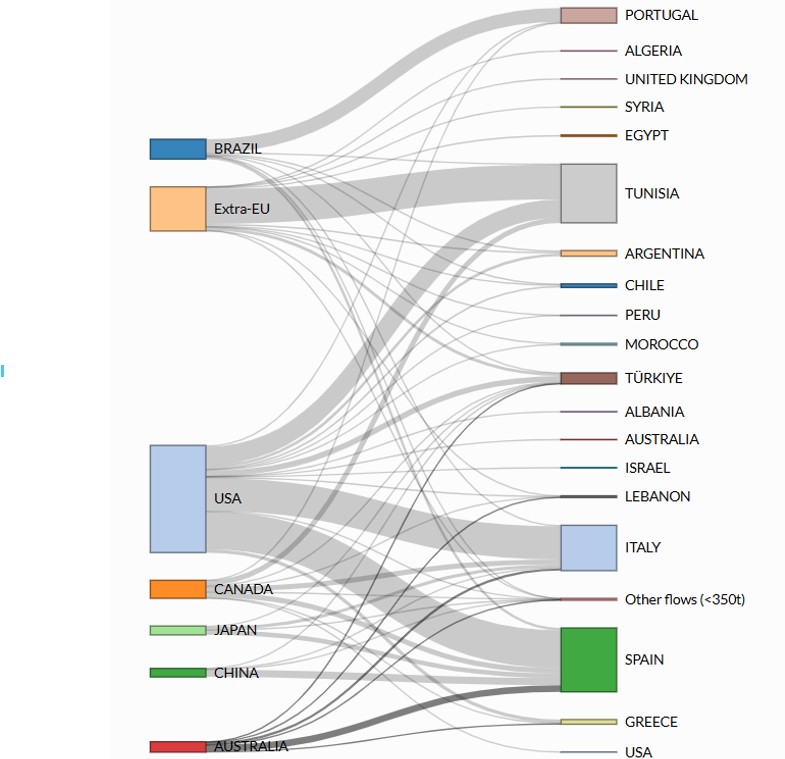
Figure 1. Olive oil import flows from selected major markets and partner countries. 2024/25.

Australian imports recorded strong growth during the last crop year, reaching 42,272 tonnes (+46%). Table 1 shows the evolution of imports over the last six crop years for olive oil and olive pomace oil.

Spain, Italy, Türkiye, Greece and Lebanon remain the main suppliers to Australia, jointly accounting for 97.3% of total imports. In the 2024/25 crop year, compared with the previous crop year, imports increased significantly from Türkiye (+187.8%), Greece (+162.4%) and Lebanon (+158.7%), alongside more moderate increases from Spain (+40.4%) and Italy (+25.1%).
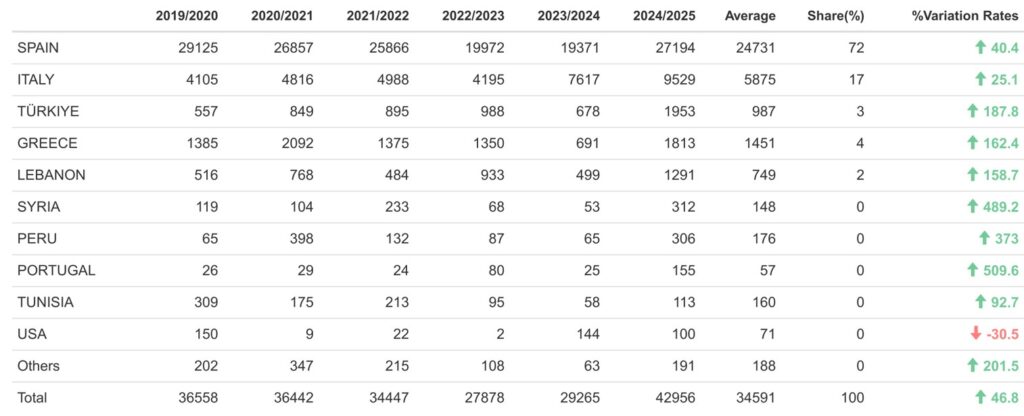
Table 1. Imports of olive oil and olive pomace oil into Australia by partner country (2019/20 – 2024/25) (t).

In terms of product categories, 72.9% of imports correspond to virgin olive oils, followed by 25.5% corresponding to olive oils (classified under CN code 15.09.90), while the remaining 1.6% corresponds to olive pomace oils.
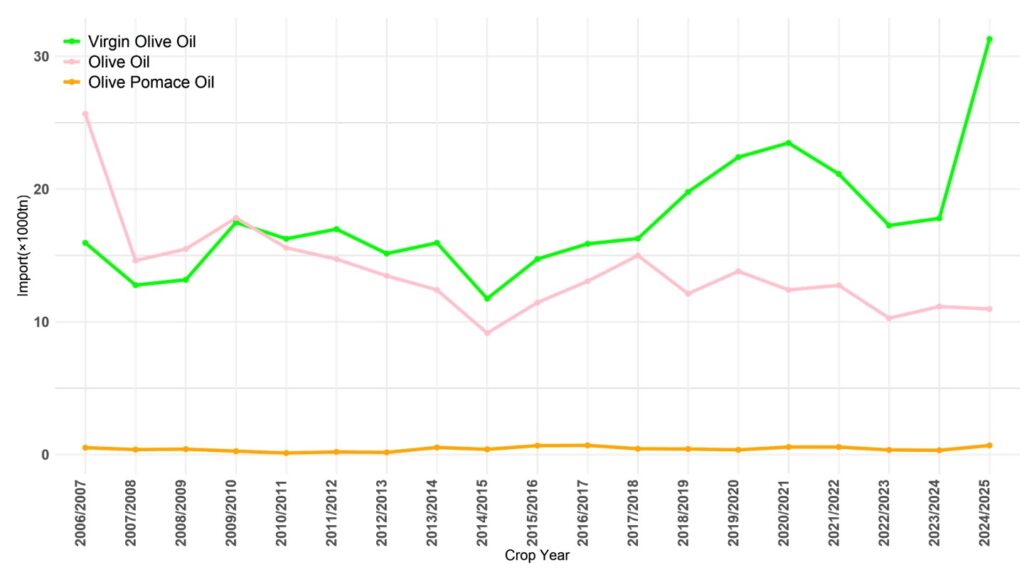
Figure 2. Evolution of Australian imports by product category (2005/06 – 2024/25) (×1,000 t).
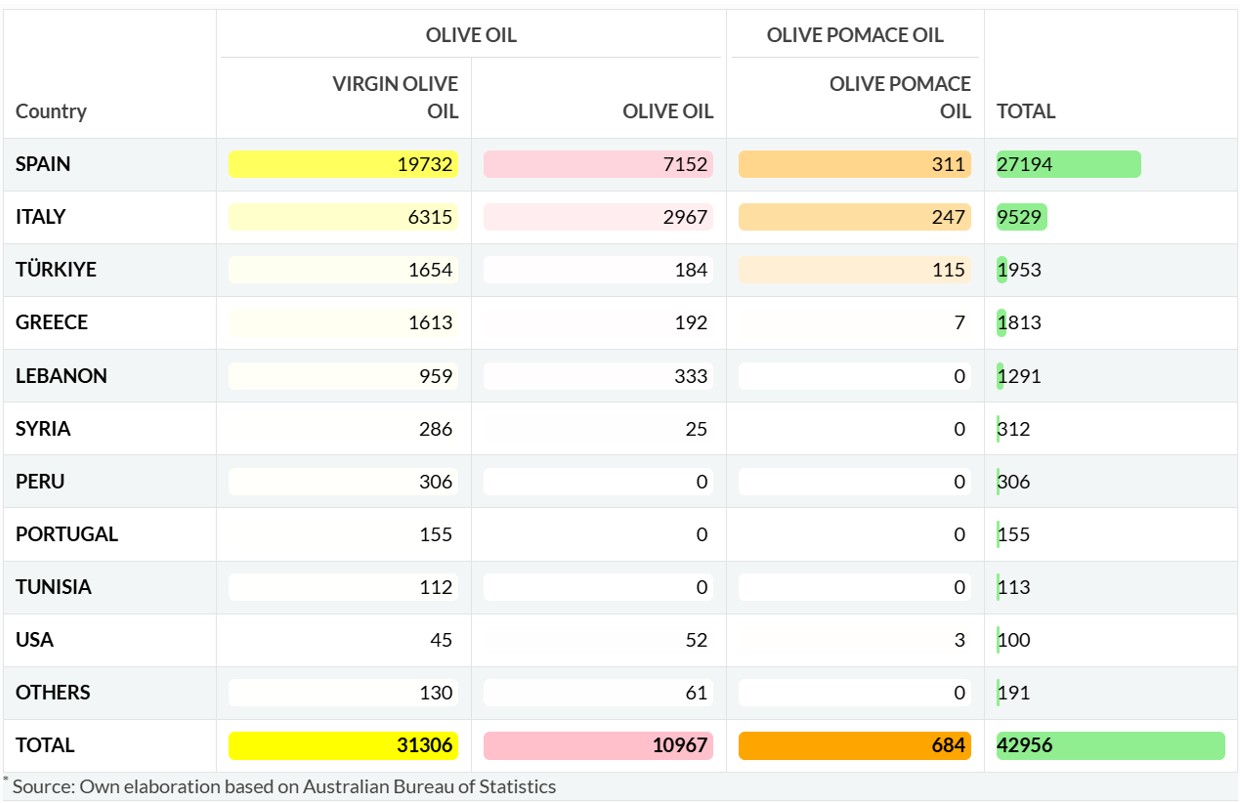
Table 2. Distribution of Australian imports by product category and partner country (2024/25) (t).

World olive oil imports

Imports of olive oil from selected major markets during the 2025/26 crop year (October 2025 – January 2026) increased by 9.2% compared to the same period of the previous crop year. An upward trend is observed in most markets, with the exception of Canada and the United States.
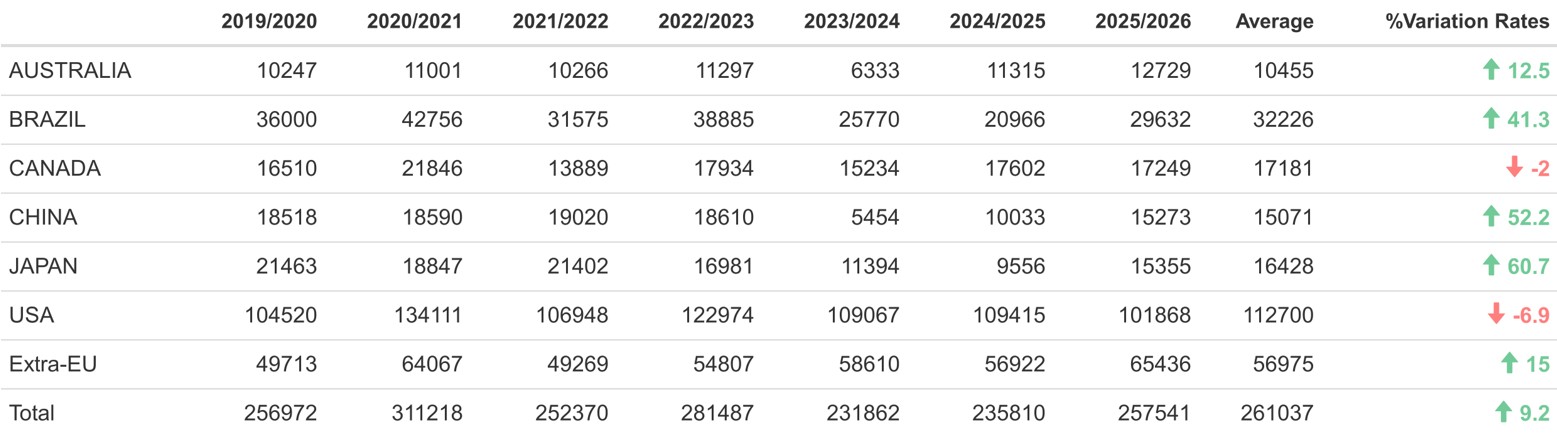
 

Table 3. Imports of olive oil from selected major markets (October 2025 – January 2026) (t).

World table olive imports

Imports of table olives from selected major markets, covering the period from September 2025 to January 2026, increased by 7.8% compared to the same period of the 2024/25 crop year.
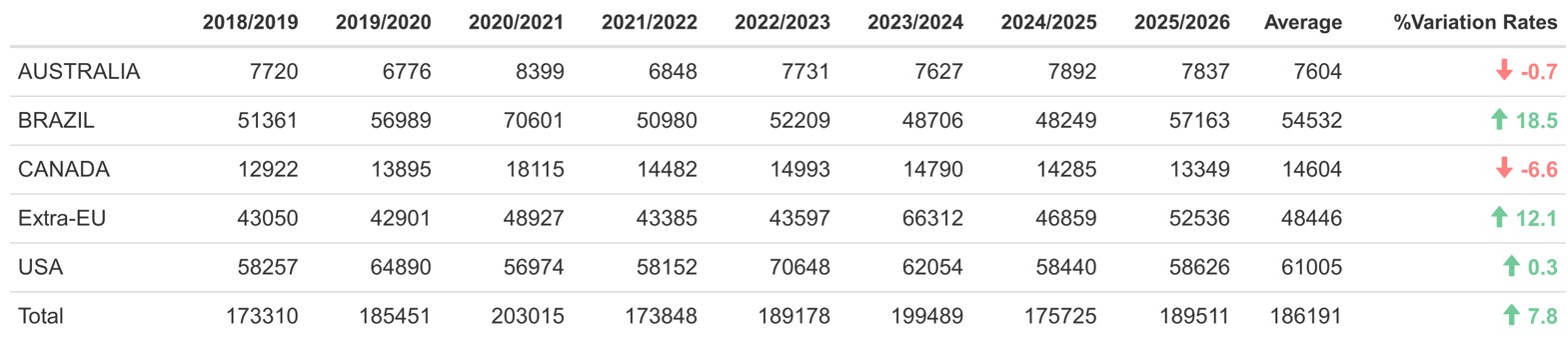
Table 4. Imports of table olives from selected major markets (September 2025 – January 2026) (t).

Prices

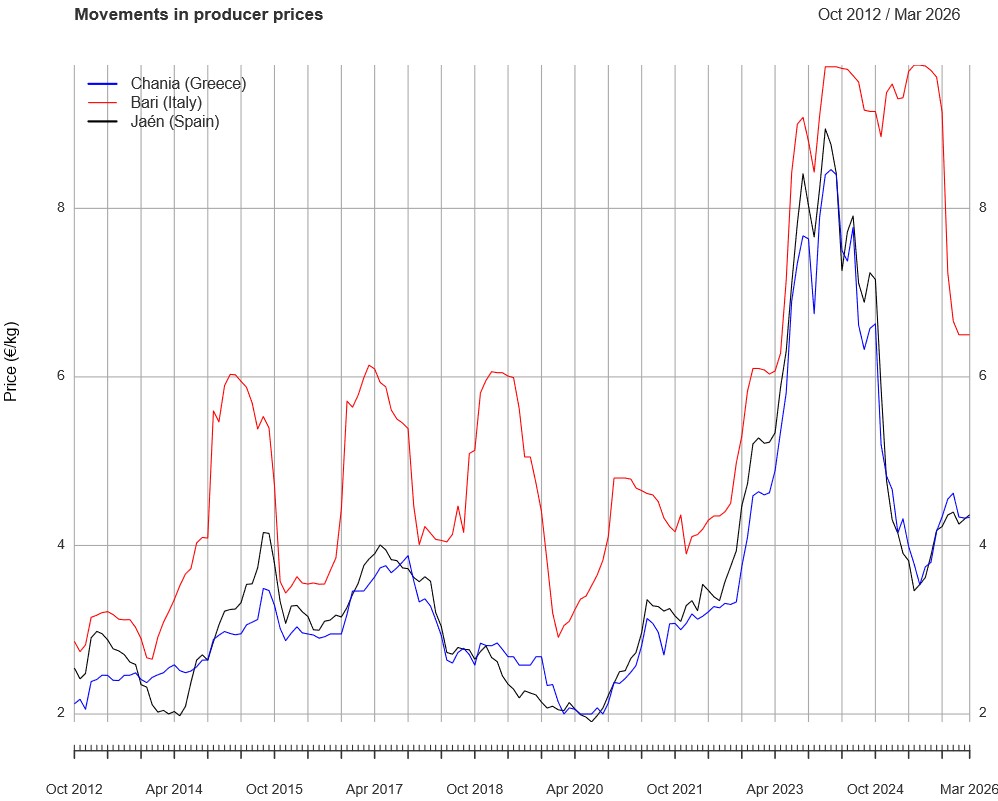
With regard to extra virgin olive oil producer prices:

  • Jaén (Spain): in the week of 16–22 March, €438.5/100 kg, representing an increase of 14.8% compared to the same week of the previous crop year.
  • Bari (Italy): in the same week, €650/100 kg (-30.1%).
  • Chania (Greece): €430/100 kg (+1.2%).


Figure 3. Evolution of monthly extra virgin olive oil producer prices.

Some data are subject to revision. Figures may be updated or corrected without prior notice.
Enviar noticiaShare Enlace a facebook Enlace a twitter Enlace a linkedin
Derniers Messages
Olive sector statistics – April 2026
MADRID, SPAIN / 08.04.2026

Welcome to the International Olive Council (IOC), the only intergovernmental organisation in the world bringing together all stakeholders in the production and consumption of olive oil and table olives. Here you will find a...

Info

Le COI et le CIHEAM Zaragoza organiseront deux cours régionaux de formation en mai 2026.

Le Conseil oléicole international (COI), en collaboration avec le Centre international de hautes études agronomiques méditerranéennes (CIHEAM Zaragoza), organisera deux cours régionaux de formation en mai 2026 dans le...

Info

Le COI et l’UPM signent un protocole d’accord
MADRID, ESPAGNE / 16.03.2026

Le Conseil oléicole international (COI) et l’Université polytechnique de Madrid (UPM) d’Espagne viennent de signer un protocole d’accord visant à renforcer leur coopération dans le secteur oléicole....

Info

International olive council logo
Privacy Policy
Nos réseaux sociaux
  • Linkedin icon
  • Twitter icon
© International Olive Council, 2026
Manage Cookie Consent
To provide the best experiences, we use technologies like cookies to store and/or access device information. Consenting to these technologies will allow us to process data such as browsing behavior or unique IDs on this site. Not consenting or withdrawing consent, may adversely affect certain features and functions.
Functional Toujours activé
The technical storage or access is strictly necessary for the legitimate purpose of enabling the use of a specific service explicitly requested by the subscriber or user, or for the sole purpose of carrying out the transmission of a communication over an electronic communications network.
Preferencias
El almacenamiento o acceso técnico es necesario para la finalidad legítima de almacenar preferencias no solicitadas por el abonado o usuario.
Statistics
The technical storage or access that is used exclusively for statistical purposes. El almacenamiento o acceso técnico que se utiliza exclusivamente con fines estadísticos anónimos. Sin un requerimiento, el cumplimiento voluntario por parte de tu proveedor de servicios de Internet, o los registros adicionales de un tercero, la información almacenada o recuperada sólo para este propósito no se puede utilizar para identificarte.
Marketing
The technical storage or access is required to create user profiles to send advertising, or to track the user on a website or across several websites for similar marketing purposes.
Gérer les options Gérer les services Gérer {vendor_count} fournisseurs En savoir plus sur ces finalités
View preferences
{title} {title} {title}

Culinary

Olive Oil and the Plant-Forward Kitchen

Discover how the Mediterranean Diet inspires contemporary cooking.

Explore this collaboration between the International Olive Council and The Culinary Institute of America, designed to promote healthy, sustainable and flavourful food choices, with a strong focus on technical training and menu innovation for chefs.

External link

COI logo
CIA logo

Santé

Le COI et l’Université de Navarre, à travers l’OHIS (de l’anglais Olive Health Information System), une plateforme dédiée à la recherche sur les propriétés de l’huile d’olive et des olives de table sur la santé, publient chaque semaine ou toutes les deux semaines un recueil d’articles scientifiques et une synthèse des recherches menées dans ce domaine.

Ces articles mettent en lumière les nombreux bienfaits de ces produits pour la santé.

Vous pouvez lire les résumés de ces recherches ici en français, anglais et espagnol et accéder à la liste des articles, ou visiter le portail OHIS.

Summaries OHIS portal

Pour toute assistance, veuillez contacter iooc@internationaloliveoil.org.

Sustainability in the Olive Sector

Access the sustainability portal developed in collaboration between the IOC, the University of Jaén and the Instituto Universitario de Investigación en Olivar y Aceites de Oliva.

Explore research, tools and knowledge supporting sustainable olive growing and responsible production practices.

External link

X