
• Skip to main content

International Olive Council

The website of the International Olive Council

Logo du Conseil oléicole international
Linkedin icon Twitter icon
  • Santé
  • Alimentation
  • Durabilité
Marchés Subventions Postes Vacants Parrainage
Mail envelope Contact
Magnifier Recherche
Person icon Espace Privé
Person icon
Menu icon
MENUMENU
  • Le Coi
    • Message de Bienvenue
    • Missions et Textes de Base
    • Structure
    • Liste des pays membres du COI
    • Où sommes-nous
    • Actualités
  • Nos Missions
    • Unité de Normalisation et Recherche
      • Normes, Méthodes et Guides COI
      • Groupes de Travail
      • Agrément aux Laboratoires et aux Jurys de Dégustateurs
      • Prix à la Qualité Mario Solinas
      • Soutien institutionnel du COI
      • Huile d’Olive, Nutrition et Santé
      • Recherche au Sein de l’Unité de Normalisationet Recherche
      • Base de données des documents du COI
    • Unité Oléiculture, Oléotechnie et Environnement
      • Technical Cooperation and Training
      • Olive Oil Technology and the Environment
      • IOC Scholarships
      • Supporting Member Countries
      • External Projects and Institutional Agreements
      • IOC Network of International Olive Germplasm Banks
      • Key Projects and Technical Resources
    • Unité de Gestion Financière
    • Unité d’Économie et de Promotion
      • Market Statistics
      • Country Profiles
      • Promotion Campaigns
      • Grants for Promotion Activities
      • Studies & Seminars
    • Unité De Gestion Administrative Et Des Ressources Humaines
    • Le Département de l’Observatoire et des Systèmes d'Information
    • Santé
    • Alimentation
    • Durabilité
    • Statistiques
  • Le Monde de l'Olivier
    • L’olivier
    • Les olives de table
    • L’huile d’olive
    • L’Huile d’Olive et la Santé
    • Préparer les olives chez soi
    • Musées et Routes de L’olivier
    • La Journée Mondiale de l’Olivier
      • Célébrations de la Journée mondiale de l’olivier
    • Recettes
  • Ressources
    • Projet Bilan Carbone
    • Catalogue mondial des variétés d'olivier
    • IOC Published Documents
    • Videos
    • Infographics
  • Normes
  • Statistiques
  • Arabe
  • Anglais
  • Français
  • Italien
  • Espagnol
Marchés Subventions Postes Vacants Parrainage
Mail envelope Contact
Magnifier Recherche
Nos réseaux sociaux
  • Linkedin icon
  • Twitter icon
MENUMENU
  • Le Coi
    • Message de Bienvenue
    • Missions et Textes de Base
    • Structure
    • Liste des pays membres du COI
    • Où sommes-nous
    • Actualités
  • Nos Missions
    • Unité de Normalisation et Recherche
      • Normes, Méthodes et Guides COI
      • Groupes de Travail
      • Agrément aux Laboratoires et aux Jurys de Dégustateurs
      • Prix à la Qualité Mario Solinas
      • Soutien institutionnel du COI
      • Huile d’Olive, Nutrition et Santé
      • Recherche au Sein de l’Unité de Normalisationet Recherche
      • Base de données des documents du COI
    • Unité Oléiculture, Oléotechnie et Environnement
      • Technical Cooperation and Training
      • Olive Oil Technology and the Environment
      • IOC Scholarships
      • Supporting Member Countries
      • External Projects and Institutional Agreements
      • IOC Network of International Olive Germplasm Banks
      • Key Projects and Technical Resources
    • Unité de Gestion Financière
    • Unité d’Économie et de Promotion
      • Market Statistics
      • Country Profiles
      • Promotion Campaigns
      • Grants for Promotion Activities
      • Studies & Seminars
    • Unité De Gestion Administrative Et Des Ressources Humaines
    • Le Département de l’Observatoire et des Systèmes d'Information
    • Santé
    • Alimentation
    • Durabilité
    • Statistiques
  • Le Monde de l'Olivier
    • L’olivier
    • Les olives de table
    • L’huile d’olive
    • L’Huile d’Olive et la Santé
    • Préparer les olives chez soi
    • Musées et Routes de L’olivier
    • La Journée Mondiale de l’Olivier
      • Célébrations de la Journée mondiale de l’olivier
    • Recettes
  • Ressources
    • Projet Bilan Carbone
    • Catalogue mondial des variétés d'olivier
    • IOC Published Documents
    • Videos
    • Infographics
  • Normes
  • Statistiques
  • Arabe
  • Anglais
  • Français
  • Italien
  • Espagnol
  • Santé
  • Alimentation
  • Durabilité
Tools icon

IOC NEWS

Home / Blog / Behaviour study: the aims of IOC’s research
Enviar noticiaShare Enlace a facebook Enlace a twitter Enlace a linkedin

Behaviour study: the aims of IOC’s research

Madrid / 08.01.2022

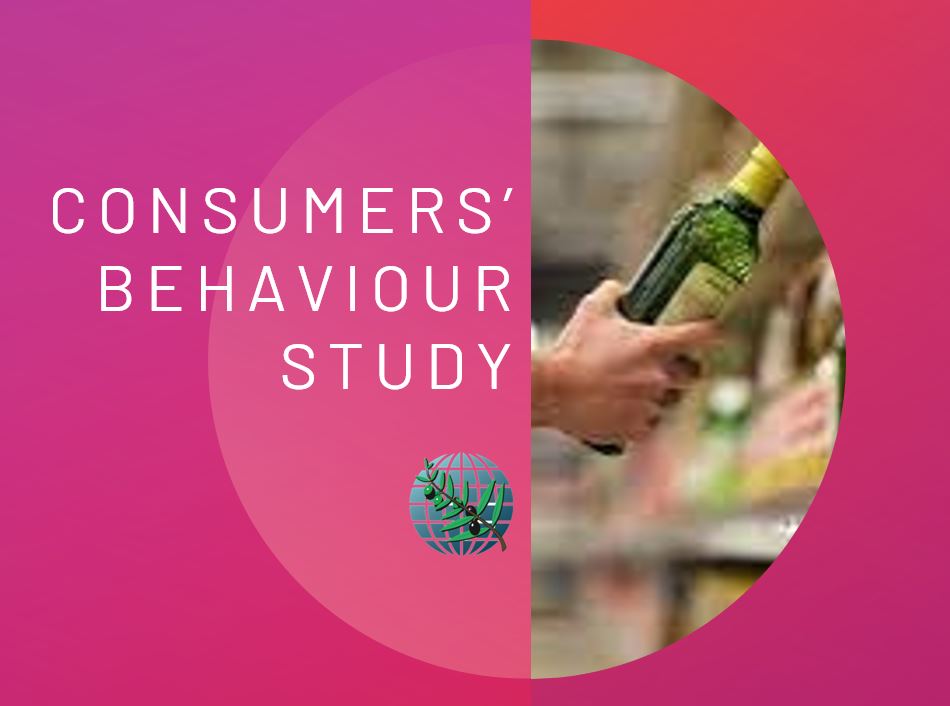
The IOC’s Executive Secretariat is conducting since 2020 a survey on consumer behaviour regarding the consumption of virgin olive oil category in some producing and consuming countries.  The aims of this interesting research are indicated below.

1. To analyse the changes and trends in the consumption of olive oil in IOC member countries compared with other edible oils and fats to determine whether consumption has fallen in olive oils only, or whether there has been an overall reduction in the consumption of fats. As far as possible, the analysis is carried out according to the type of olive oil (EVOO, VOO and OO). Factors of change in eating habits, especially those affecting consumption patterns, will also be examined.

2. To analyse consumer behaviour with regard to edible oils and fats in general, and olive oil in particular,
in IOC member countries to determine:

  • The domestic use of olive oil (consumer households, non-consumer households, households usingexclusively olive oil, households using both olive oil and sunflower oil, etc.)
  • Reasons not to use olive oil.
  • Oils and fats used according to the objectives (frying, salad dressing, deep-frying, baking, stewing,etc.).
  • The reasons for buying or using oils and fats for each purpose.
  • The image or perception of olive oils according to the qualities or advantages sought in the purchase/ consumption (price, quality, health, environment, taste, etc.).
  • Points of sale and purchase terms, use of information and communication technologies.
  • Brands.
  • The level of knowledge of the different types of olive oil on the market.
  • Sources of information on food in general and olive oil in particular. Consumer’s sensitivity to price, what they are willing to pay.
  • Market segments according to sociodemographic and psychographic variables.
  • The intention to repurchase when the consumer has stopped buying oil.

The study is ongoing. In the year 2020 covered Spain, Italy and Greece, countries where consumption has fallen sharply. In 2021, it covered Argentina, Egypt, Tunisia and Jordan. In 2022, the study will be completed and other countries will be studied.

For further information you can reach this link: https://www.internationaloliveoil.org/what-we-do/economic-affairs-promotion-unit/


Enviar noticiaShare Enlace a facebook Enlace a twitter Enlace a linkedin
Derniers Messages
Le COI et la TAGEM signent un protocole d’accord
ESPAGNE/TURQUIE / 06.03.2026

Le Conseil oléicole international (COI) et la Direction générale de la recherche et des politiques agricoles (TAGEM) de Turquie viennent de signer un protocole d’accord visant à renforcer leur coopération dans...

Info

Le directeur exécutif du COI inaugure la WOOE
MADRID, ESPAGNE / 05.03.2026

Le directeur exécutif du Conseil oléicole international (COI) a inauguré la 13ᵉ édition de la World Olive Oil Exhibition (WOOE) à Madrid le 3 mars, l’un des principaux rendez-vous internationaux du secteur de...

Info

Le COI célèbre les jeunes talents culinaires des Pouilles
POUILLES, ITALIE / 04.03.2026

L’organisation réaffirme son engagement auprès du secteur oléicole italien La semaine dernière, le Conseil oléicole international (COI) s’est rendu dans les Pouilles, principale région productrice d’huile...

Info

International olive council logo
Privacy Policy
Nos réseaux sociaux
  • Linkedin icon
  • Twitter icon
© International Olive Council, 2026
Manage Cookie Consent
To provide the best experiences, we use technologies like cookies to store and/or access device information. Consenting to these technologies will allow us to process data such as browsing behavior or unique IDs on this site. Not consenting or withdrawing consent, may adversely affect certain features and functions.
Functional Toujours activé
The technical storage or access is strictly necessary for the legitimate purpose of enabling the use of a specific service explicitly requested by the subscriber or user, or for the sole purpose of carrying out the transmission of a communication over an electronic communications network.
Preferencias
El almacenamiento o acceso técnico es necesario para la finalidad legítima de almacenar preferencias no solicitadas por el abonado o usuario.
Statistics
The technical storage or access that is used exclusively for statistical purposes. El almacenamiento o acceso técnico que se utiliza exclusivamente con fines estadísticos anónimos. Sin un requerimiento, el cumplimiento voluntario por parte de tu proveedor de servicios de Internet, o los registros adicionales de un tercero, la información almacenada o recuperada sólo para este propósito no se puede utilizar para identificarte.
Marketing
The technical storage or access is required to create user profiles to send advertising, or to track the user on a website or across several websites for similar marketing purposes.
Gérer les options Gérer les services Gérer {vendor_count} fournisseurs En savoir plus sur ces finalités
View preferences
{title} {title} {title}

Culinary

Olive Oil and the Plant-Forward Kitchen

Discover how the Mediterranean Diet inspires contemporary cooking.

Explore this collaboration between the International Olive Council and The Culinary Institute of America, designed to promote healthy, sustainable and flavourful food choices, with a strong focus on technical training and menu innovation for chefs.

External link

COI logo
CIA logo

Santé

Le COI et l’Université de Navarre, à travers l’OHIS (de l’anglais Olive Health Information System), une plateforme dédiée à la recherche sur les propriétés de l’huile d’olive et des olives de table sur la santé, publient chaque semaine ou toutes les deux semaines un recueil d’articles scientifiques et une synthèse des recherches menées dans ce domaine.

Ces articles mettent en lumière les nombreux bienfaits de ces produits pour la santé.

Vous pouvez lire les résumés de ces recherches ici en français, anglais et espagnol et accéder à la liste des articles, ou visiter le portail OHIS.

Summaries OHIS portal

Pour toute assistance, veuillez contacter iooc@internationaloliveoil.org.

Sustainability in the Olive Sector

Access the sustainability portal developed in collaboration between the IOC, the University of Jaén and the Instituto Universitario de Investigación en Olivar y Aceites de Oliva.

Explore research, tools and knowledge supporting sustainable olive growing and responsible production practices.

External link

X