• Skip to main content

International Olive Council

The website of the International Olive Council

Logo del Consiglio Oleicolo Internazionale
Linkedin icon Twitter icon
  • Salute
  • Culinario
  • Sostenibilità
Appalti Sovvenzioni Opportunità di Lavoro Patronage
Mail envelope Contatti
Magnifier CERCA
Person icon Area Riservata
Person icon
Menu icon
MENUMENU
  • Who we are
    • Mission and Vision
    • Fundamental Texts
    • Governance and Structure
    • Member Countries and Observers
  • What we do
    • Unità Standardizzazione e Ricerca
      • Norme, Metodi e Manuali
      • Gruppi de Lavoro
      • Laboratori e Panel Riconosciuti dal COI
      • Premio alla Qualità Mario Solinas
      • Sostegno istituzionale del COI
      • Olio di Oliva, Alimentazione e Salute
      • Attività di Ricerca presso l’Unità Standardizzazione e Ricerca
      • Database documenti del COI
    • Olive Growing, Olive Oil Technology and Environment Unit
      • Technical Cooperation and Training
      • Olive Oil Technology and the Environment
      • IOC Scholarships
      • Supporting Member Countries
      • External Projects and Institutional Agreements
      • IOC Network of International Olive Germplasm Banks
      • Key Projects and Technical Resources
    • Unità Economia e Promozione
      • Market Statistics
      • Country Profiles
      • Promotion Campaigns
      • Grants for Promotion Activities
      • Studies & Seminars
  • Olive World
    • L’olivo
    • Le olive da tavola
    • L’olio d’oliva
    • Olio d’oliva e salute
    • Olive da tavola fatte in casa
    • Musei e itinerari dell’olivo
    • Giornata Mondiale dell’Olivo
    • Ricette
    • Glossario
  • Resources
    • Carbon Balance Project
    • World Catalogue of Olive Varieties
    • Publications
    • Videos
    • Infographics
  • Norme, Metodi e Manuali
  • Statistiche
  • Arabo
  • Inglese
  • Francese
  • Italiano
  • Spagnolo
Appalti Sovvenzioni Opportunità di Lavoro Patronage
Mail envelope Contatti
Magnifier CERCA
We are social
  • Linkedin icon
  • Twitter icon
MENUMENU
  • Who we are
    • Mission and Vision
    • Fundamental Texts
    • Governance and Structure
    • Member Countries and Observers
  • What we do
    • Unità Standardizzazione e Ricerca
      • Norme, Metodi e Manuali
      • Gruppi de Lavoro
      • Laboratori e Panel Riconosciuti dal COI
      • Premio alla Qualità Mario Solinas
      • Sostegno istituzionale del COI
      • Olio di Oliva, Alimentazione e Salute
      • Attività di Ricerca presso l’Unità Standardizzazione e Ricerca
      • Database documenti del COI
    • Olive Growing, Olive Oil Technology and Environment Unit
      • Technical Cooperation and Training
      • Olive Oil Technology and the Environment
      • IOC Scholarships
      • Supporting Member Countries
      • External Projects and Institutional Agreements
      • IOC Network of International Olive Germplasm Banks
      • Key Projects and Technical Resources
    • Unità Economia e Promozione
      • Market Statistics
      • Country Profiles
      • Promotion Campaigns
      • Grants for Promotion Activities
      • Studies & Seminars
  • Olive World
    • L’olivo
    • Le olive da tavola
    • L’olio d’oliva
    • Olio d’oliva e salute
    • Olive da tavola fatte in casa
    • Musei e itinerari dell’olivo
    • Giornata Mondiale dell’Olivo
    • Ricette
    • Glossario
  • Resources
    • Carbon Balance Project
    • World Catalogue of Olive Varieties
    • Publications
    • Videos
    • Infographics
  • Norme, Metodi e Manuali
  • Statistiche
  • Arabo
  • Inglese
  • Francese
  • Italiano
  • Spagnolo
  • Salute
  • Culinario
  • Sostenibilità
Tools icon

IOC NEWS

Home / Blog / IOC Advances Cooperation with Peru’s Olive Sector
Enviar noticiaShare Enlace a facebook Enlace a twitter Enlace a linkedin

IOC Advances Cooperation with Peru’s Olive Sector

PERU / 25.09.2025

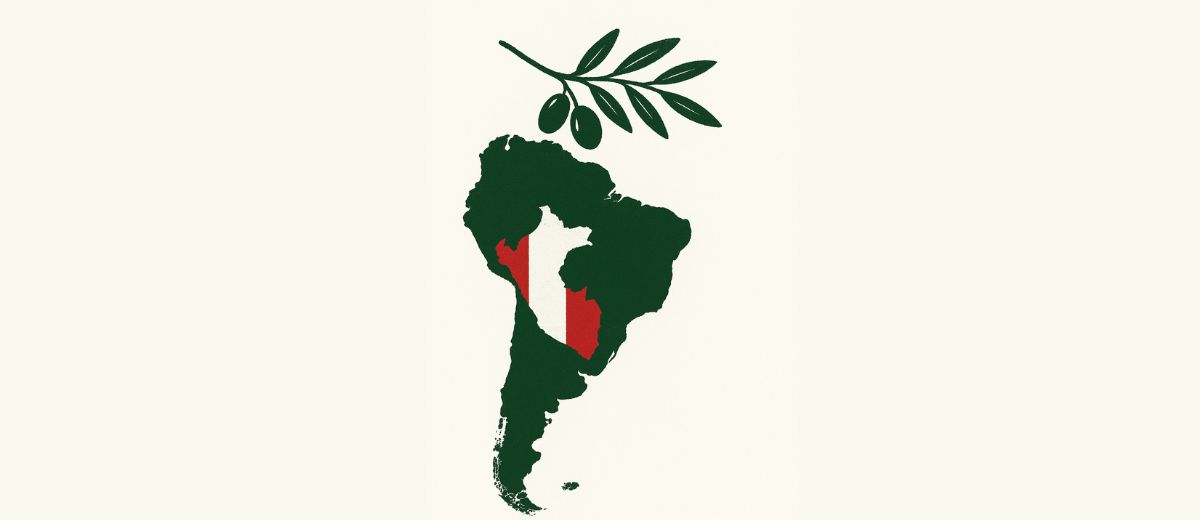
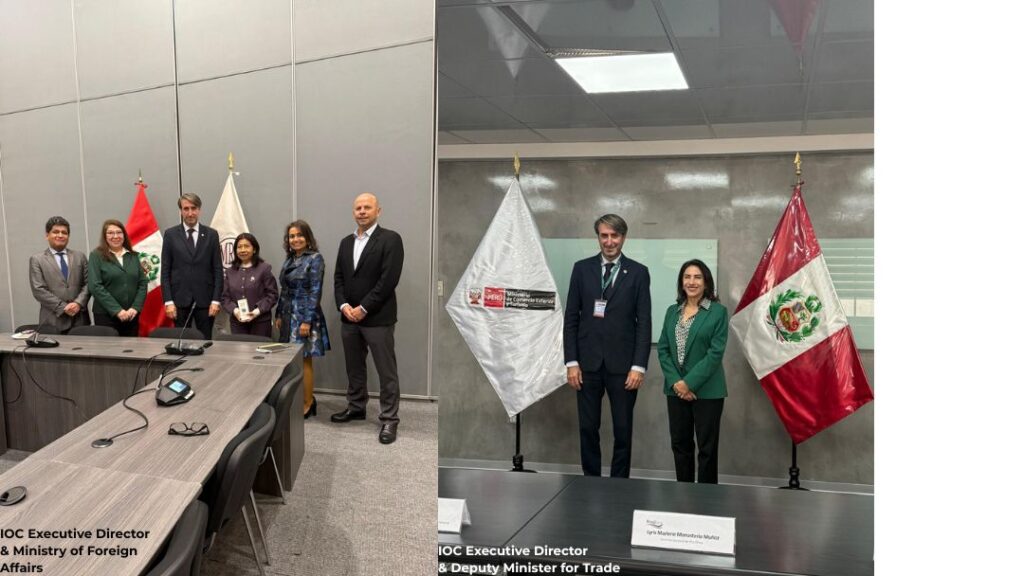
As part of its ongoing mission to promote quality standards and support sustainable growth in the global olive sector, the International Olive Council (IOC) has reinforced its engagement with Peru through a strategic visit by Executive Director Jaime Lillo from 16 to 23 September 2025. The visit to this IOC permanent observer country marked a significant step forward in bilateral cooperation, technical dialogue and Peru’s expressed interest in deepening its relationship with the IOC, particularly through its potential adherence to the International Agreement to Olive Oil and Table Olives, 2015.

Advancing Standards and Strategic Dialogue

In Lima, the Executive Director held meetings with key government institutions, including the Ministry of Foreign Affairs, the Ministry of Agricultural Development and Irrigation (MIDAGRI), the Ministry for Science, Innovation and Universities (MCIU), the Foreign Trade and Tourism Office (MINCETUR) and the National Institute for Quality (INACAL). Discussions centred on Codex Alimentarius work and the harmonisation of national technical standards for olives and olive oil with international norms established by the IOC. This alignment is critical to facilitating fair trade, ensuring product quality and building consumer trust.

Peru, which currently holds permanent observer status at the IOC, has also expressed a formal interest in becoming a full member. Several meetings during the visit were dedicated to outlining the steps for accession, including the preparation of an institutional commitment to promote IOC standards nationwide. This would include launching an IOC-led promotion campaign to raise awareness of olive oil trade standards, labelling and quality benchmarks.
Sector Engagement and Field Visits in Tacna

In Tacna, Peru’s principal olive-producing region, the Executive Director met with the regional governor and key actors from the olive-growing and processing sectors. These exchanges highlighted both the opportunities and structural challenges facing the sector — including the fragmented nature of the sector, water scarcity, and the need to diversify beyond the traditional Criolla variety.

The IOC reiterated its willingness to support Peru through technical cooperation, training and international best practices, particularly in areas such as climate adaptation, varietal improvement and quality control for export markets. Among other ongoing key projects, the Organisation is currently developing an open access methodology for olive farmers to calculate the carbon balance of their olive groves with a view to potentially incorporating it to the voluntary carbon credit market scheme.
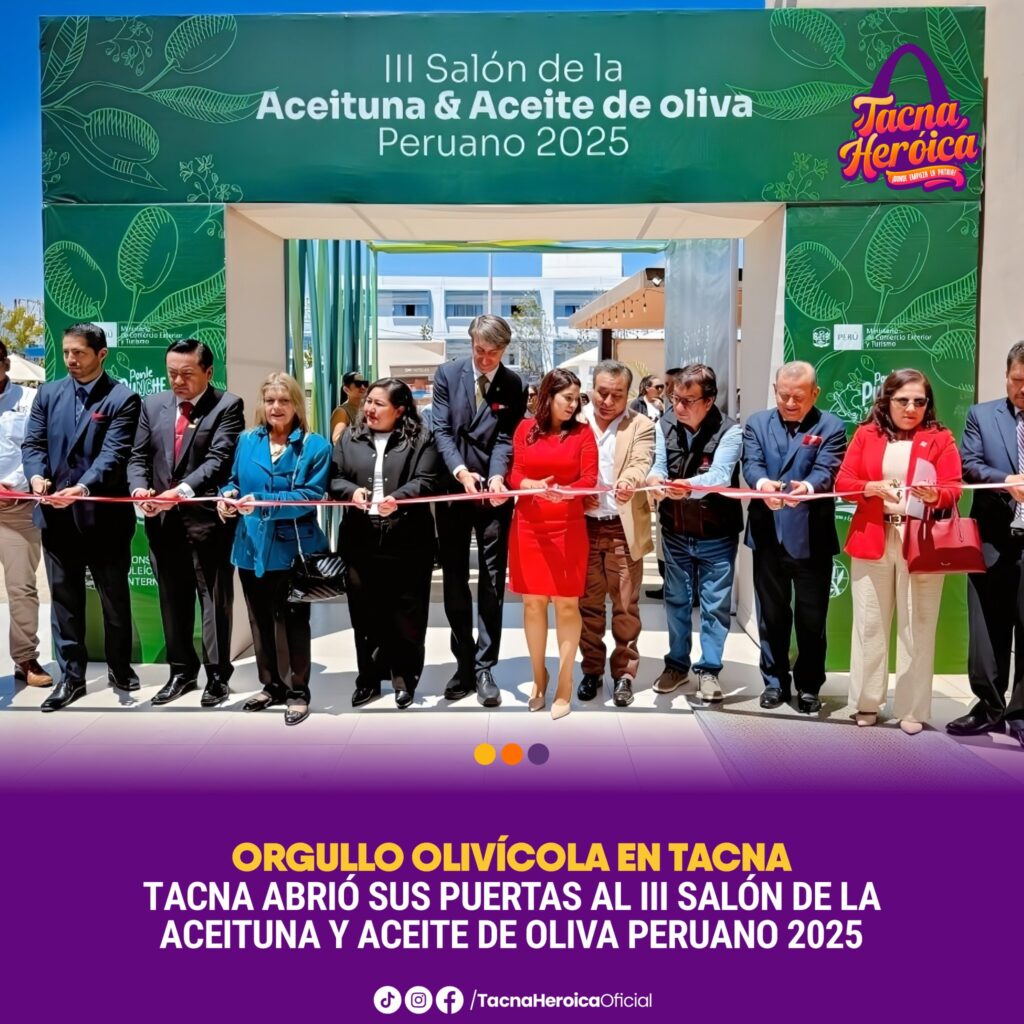
Inauguration of the 3rd Peruvian Olive and Olive Oil Fair

While in Tacna, Mr Lillo also inaugurated the 3rd Peruvian Olive and Olive Oil Fair (Salón de la Aceituna y Aceite de Oliva Peruano 2025), an event organised by PRO OLIVO with IOC institutional patronage. The fair brought together producers, exporters and specialists from across Latin America and Europe, and featured tasting sessions, technical demonstrations and international presentations.

Speaking at the opening, the Executive Director highlighted Tacna’s strategic role in the national olive economy and encouraged continued efforts to improve quality, diversify products and integrate with international markets.


Market Overview: Strong Potential and Growing Demand

Peru’s olive sector is currently focused on table olives, which represent 80% of national production. However, the olive oil segment is expanding, driven by domestic consumption and rising export prospects.

According to PRO OLIVO (2025) and Peru’s MIDAGRI (2024):

  • Around 30,000 hectares are under olive cultivation, with 20,000 currently in production.
  • Peru ranks 14th globally in total production and 8th in productivity, averaging 5,195.5 kg/ha.
  • Olive oil production reached 7,000 tonnes in 2023 and is projected to rebound to 7,000–10,000 tonnes in 2025, following a climate-induced dip.

Consumption of olive oil continues to grow, with many consumers viewing it as a healthier alternative to other vegetable oils. Imports are still needed to meet domestic demand: in 2023, Peru imported 711.9 tonnes of virgin olive oil and 410.9 tonnes of other olive oils, mainly from Spain, Türkiye and Italy.

Exports fluctuate by harvest year. In 2023, 3,000 tonnes were exported, representing 42% of production. In 2025, exports are forecast to reach 8,500 tonnes, valued at approximately US$55 million. Table olive exports remain stable at around 27,000 tonnes annually, with Brazil, Chile, the United States and Canada as key markets.

Looking Ahead

Peru’s olive sector is at a promising juncture. With institutional backing, improving standards and growing international engagement, the country is well positioned to scale up production, improve quality and boost exports.

The IOC stands ready to accompany Peru on this path — supporting technical integration and policy development in line with international standards.
Enviar noticiaShare Enlace a facebook Enlace a twitter Enlace a linkedin
Last Posts
IOC and UPM sign MoU
MADRID, SPAIN / 16.03.2026

The International Olive Council (IOC) and the Polytechnic University of Madrid (UPM) in Spain have signed a Memorandum of Understanding (MoU) to strengthen cooperation in the olive sector. The agreement was signed by Mr...

Info

This week on OHIS
MADRID, SPAIN / 13.03.2026

This week on the Olive Health Information System website The newsletter of the University of Navarra and the IOC dedicated to health Article 1 Recent studies have examined the role of overall dietary patterns in...

Info

European Day for the Prevention of Cardiovascular Risk
MADRID, SPAIN / 13.03.2026

Olive oil, an ally in cardiovascular prevention On the occasion of the European Day for the Prevention of Cardiovascular Risk, the International Olive Council (IOC) reiterates the importance of preventing cardiovascular...

Info

International olive council logo
Privacy Policy
Il COI sulle reti sociali
  • Linkedin icon
  • Twitter icon
© International Olive Council, 2026
Manage Cookie Consent
To provide the best experiences, we use technologies like cookies to store and/or access device information. Consenting to these technologies will allow us to process data such as browsing behavior or unique IDs on this site. Not consenting or withdrawing consent, may adversely affect certain features and functions.
Functional Sempre attivo
The technical storage or access is strictly necessary for the legitimate purpose of enabling the use of a specific service explicitly requested by the subscriber or user, or for the sole purpose of carrying out the transmission of a communication over an electronic communications network.
Preferencias
El almacenamiento o acceso técnico es necesario para la finalidad legítima de almacenar preferencias no solicitadas por el abonado o usuario.
Statistics
The technical storage or access that is used exclusively for statistical purposes. El almacenamiento o acceso técnico que se utiliza exclusivamente con fines estadísticos anónimos. Sin un requerimiento, el cumplimiento voluntario por parte de tu proveedor de servicios de Internet, o los registros adicionales de un tercero, la información almacenada o recuperada sólo para este propósito no se puede utilizar para identificarte.
Marketing
The technical storage or access is required to create user profiles to send advertising, or to track the user on a website or across several websites for similar marketing purposes.
Gestisci opzioni Gestisci servizi Gestisci {vendor_count} fornitori Per saperne di più su questi scopi
View preferences
{title} {title} {title}

Culinary

Olive Oil and the Plant-Forward Kitchen

Discover how the Mediterranean Diet inspires contemporary cooking.

Explore this collaboration between the International Olive Council and The Culinary Institute of America, designed to promote healthy, sustainable and flavourful food choices, with a strong focus on technical training and menu innovation for chefs.

External link

COI logo
CIA logo

Salute

The IOC and the University of Navarra, through OHIS (the Olive Health Information System), a platform dedicated to research on the health properties of olive oil and table olives, publish a weekly or bi-weekly collection of scientific articles and summaries of research carried out in this field.

These articles highlight the numerous health benefits of these products.

You can read the summaries of this research here in French, English and Spanish and access the list of articles, or visit the OHIS portal.

Summaries OHIS portal

For any assistance, please contact iooc@internationaloliveoil.org.

Sustainability in the Olive Sector

Access the sustainability portal developed in collaboration between the IOC, the University of Jaén and the Instituto Universitario de Investigación en Olivar y Aceites de Oliva.

Explore research, tools and knowledge supporting sustainable olive growing and responsible production practices.

External link

X