
 Share
Share


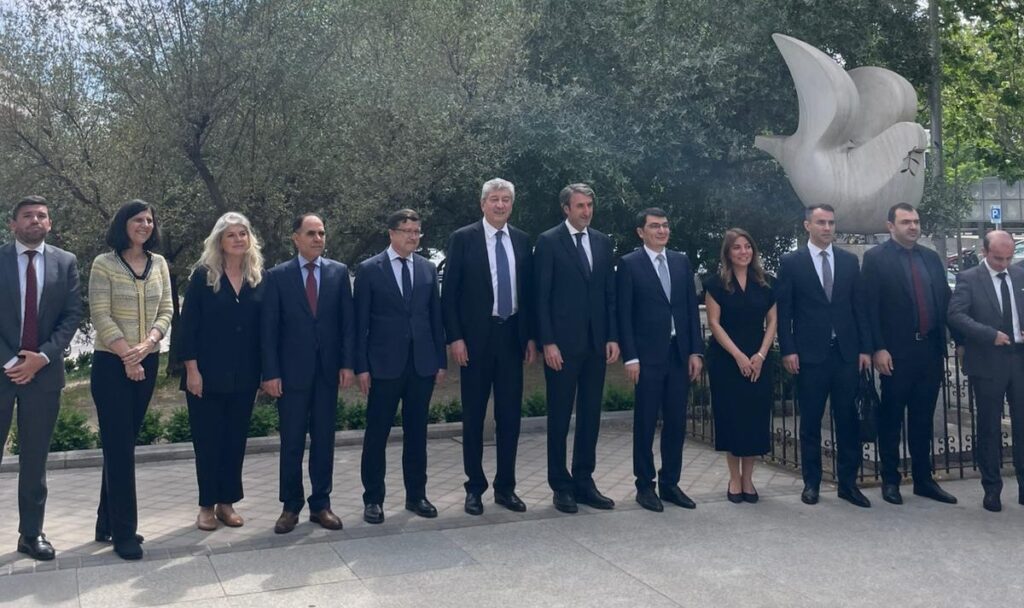
The International Olive Council (IOC) welcomed a high-level delegation from the Republic of Azerbaijan on 20 April for a working visit aimed at strengthening institutional dialogue and consolidating cooperation following the country’s accession to the Organisation in 2024.
The delegation was led by H.E. Mr Elnur Aliyev, First Deputy Minister of Economy of Azerbaijan. The meeting opened with remarks by the IOC Executive Director, Mr Jaime Lillo, and H.E. Mr Aliyev, highlighting the importance of active engagement between the IOC and its Member Countries.
During the session, the IOC presented its core activities across strategic, operational, financial and administrative areas, with particular emphasis on technical cooperation, training programmes and capacity-building initiatives. The Organisation encouraged Azerbaijan to actively participate in these activities and to nominate candidates in order to fully benefit from IOC programmes.
The agenda also included contributions from representatives of the Azerbaijani private sector, with presentations by Mr Nijat Ibrahimov (Azersun Holding) and Mr Said Namazov (Grand Agro), who shared insights into their activities and perspectives on the development of the agri-food sector.
From the IOC’s perspective, the active involvement of all its Members is essential to advancing the Organisation’s mission. Strengthening collaboration, promoting knowledge exchange and supporting sector development remain central priorities, and the IOC stands ready to work closely with Azerbaijan in this regard.
A sector with growth potential
Recent data (average of the last three crop years: 2022/23–2024/25) indicate that Azerbaijan’s olive sector remains modest in scale but shows clear potential for further development. Olive oil production averages around 1500 tonnes, compared with consumption of approximately 2000 tonnes, resulting in a reliance on imports estimated at 500 tonnes.
In the table olive sector, production stands at around 4500 tonnes, while consumption reaches approximately 5200 tonnes, suggesting additional room for growth in domestic supply.
This gap between production and consumption points to opportunities for expanding national production, improving productivity and strengthening the value chain. In this context, closer cooperation with the IOC and active participation in its programmes can support the sustainable development and competitiveness of the sector in Azerbaijan.