
 Share
Share


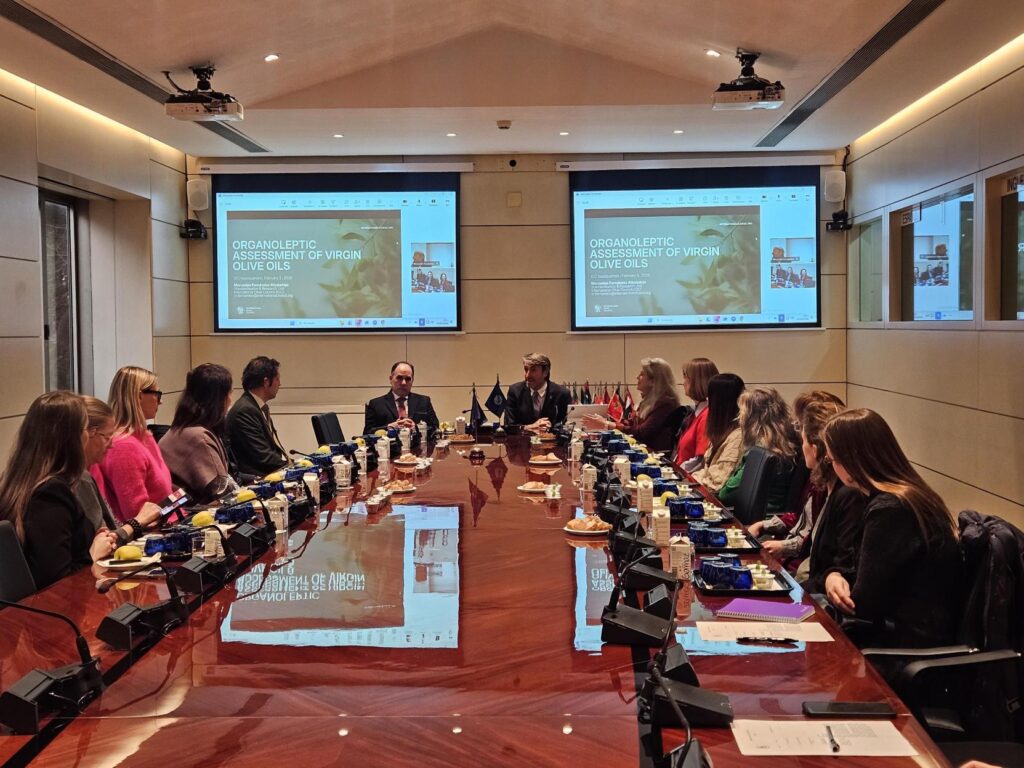
The International Olive Council (IOC) welcomed today a group of agricultural counsellors from several European embassies in Madrid for a dedicated virgin olive oil tasting session at its headquarters.
The event was held at the initiative of the Embassy of the Netherlands in Madrid and coordinated by the IOC’s Standardisation and Research Unit. It brought together diplomatic representatives from the Netherlands, Bulgaria, Latvia, France, Finland, Romania and Malta, as well as officials from Spain’s Ministry of Agriculture. All of these countries are IOC member states, represented collectively through the European Union.
Participants engaged in a combined theoretical and practical session designed to deepen their understanding of the sensory qualities and analytical standards that define virgin olive oil. Through guided tastings, they explored the positive attributes of various award-winning oils from the latest IOC Mario Solinas Quality Award on the quality of extra virgin olive oils. They also learned to recognise certain sensory defects that can be present in virgin olive oil, discovering how sensory analysis and physico-chemical analyses are used together to assess the quality and authenticity of oils.
The session, which was led by the Head of the Standardisation and Research Unit, Dr Mercedes Fernández Albaladejo, also highlighted the richness of olive oil varieties and their impact on flavour, aroma and nutritional profile. The IOC’s World Catalogue of Olive Varieties, which details over 400 different types of olives, was presented as a reference point for appreciating this diversity.
In addition, the IOC drew attention to its ongoing work in the area of health promotion. Through the Olive Health Information System (OHIS), developed in partnership with the University of Navarra, the IOC regularly publishes scientific updates—weekly or bi-weekly—on the health benefits of olive oil and table olives (in English, French and Spanish).
This event is a reflection of the IOC’s unique role in convening international stakeholders to share knowledge and foster appreciation for the olive sector’s contributions to quality, culture and health.