
• Skip to main content

International Olive Council

The website of the International Olive Council

Logo Consejo Oleícola Internacional
Linkedin icon Twitter icon
  • Salud
  • Culinario
  • Sostenibilidad
Contratos Subvenciones Vacantes Patrocinio
Mail envelope Contacto
Magnifier Buscar
Person icon Área Privada
Person icon
Menu icon
MENUMENU
  • Who we are
    • Mission and Vision
    • Fundamental Texts
    • Governance and Structure
    • Member Countries and Observers
  • Qué Hacemos
    • Unidad de Normalización e Investigación
      • Normas COI, Métodos y Guías
      • Grupos de Trabajo
      • Reconocimiento de Laboratorios y Paneles
      • Premio del COI a la Calidad Mario Solinas
      • Apoyo Institucional del COI
      • Aceite de Oliva, Nutrición y Salud
      • Investigación en la Unidad de Normalización e Investigación
      • Base de Datos de Documentos del COI
    • Olive Growing, Olive Oil Technology and Environment Unit
      • Technical Cooperation and Training
      • Olive Oil Technology and the Environment
      • IOC Scholarships
      • Supporting Member Countries
      • External Projects and Institutional Agreements
      • IOC Network of International Olive Germplasm Banks
      • Key Projects and Technical Resources
    • Unidad de Asuntos Econónicos y Promoción
      • Market Statistics
      • Country Profiles
      • Promotion Campaigns
      • Grants for Promotion Activities
      • Studies & Seminars
  • Press Room
    • Todos los artículos
    • Olive Health Information System
    • Monthly olive-sector statistics
    • Agenda 2026
    • Videos
    • Infographics
  • Key Projects
    • Carbon Balance Project
    • Catálogo mundial de variedades del olivo
    • El Día Mundial del Olivo
      • Celebraciones del Día Mundial del Olivo
    • IOC Published Documents
    • Glossary of olive terms
  • Normas
  • Estadísticas
  • Árabe
  • Inglés
  • Francés
  • Italiano
  • Español
Contratos Subvenciones Vacantes Patronage
Mail envelope Contacto
Magnifier Buscar
We are social
  • Linkedin icon
  • Twitter icon
MENUMENU
  • Who we are
    • Mission and Vision
    • Fundamental Texts
    • Governance and Structure
    • Member Countries and Observers
  • Qué Hacemos
    • Unidad de Normalización e Investigación
      • Normas COI, Métodos y Guías
      • Grupos de Trabajo
      • Reconocimiento de Laboratorios y Paneles
      • Premio del COI a la Calidad Mario Solinas
      • Apoyo Institucional del COI
      • Aceite de Oliva, Nutrición y Salud
      • Investigación en la Unidad de Normalización e Investigación
      • Base de Datos de Documentos del COI
    • Olive Growing, Olive Oil Technology and Environment Unit
      • Technical Cooperation and Training
      • Olive Oil Technology and the Environment
      • IOC Scholarships
      • Supporting Member Countries
      • External Projects and Institutional Agreements
      • IOC Network of International Olive Germplasm Banks
      • Key Projects and Technical Resources
    • Unidad de Asuntos Econónicos y Promoción
      • Market Statistics
      • Country Profiles
      • Promotion Campaigns
      • Grants for Promotion Activities
      • Studies & Seminars
  • Press Room
    • Todos los artículos
    • Olive Health Information System
    • Monthly olive-sector statistics
    • Agenda 2026
    • Videos
    • Infographics
  • Key Projects
    • Carbon Balance Project
    • Catálogo mundial de variedades del olivo
    • El Día Mundial del Olivo
      • Celebraciones del Día Mundial del Olivo
    • IOC Published Documents
    • Glossary of olive terms
  • Normas
  • Estadísticas
  • Árabe
  • Inglés
  • Francés
  • Italiano
  • Español
  • Salud
  • Culinario
  • Sostenibilidad
Tools icon

IOC NEWS

Home / Blog / 2020/21 crop year: production down, consumption up
Enviar noticiaShare Enlace a facebook Enlace a twitter Enlace a linkedin

2020/21 crop year: production down, consumption up

Madrid / 05.07.2021
IOC estimates show the highs and lows of the crop year as the sector recovers from the pandemic. Consumption was stable, but production fell, and price trends reflect the swing between supply and demand.

According to the estimates of the International Olive Council (IOC), the data for the 2020/21 crop year, albeit provisional, put production at 3 034 000 t, down 6.9% compared to the previous crop year. Consumption, on the other hand, is expected to do better, at around 3 211 000 t (-0.2%). Imports are expected around 1 074 000 t (-9.3%), while exports are expected to reach 1 132 000 t, down 8.8% from the previous year.

Leading the way in production are the IOC member countries, which alone will produce 2 834 000 t, or 93.4% of the world total, in the 2020/21 crop year. European production is set to stand at 2 057 000t, up 7% from the previous year. Leading the EU group is Spain, which is expected to record a 24.4% increase, with an estimated production of 1 400 000 t. This is followed by Italy with 270 000 t (-26.2%), Greece with 270 000 t (-1.8%), and Portugal with 100 000 t (-28.8%).

Production in the other member countries is expected to total 777 000 t (-32,4%). In Tunisia, production is expected to reach around 140 000 t (-68.2%), followed by Turkey with 210 000 t (-8.7%), Morocco with 160 000 t (+10.3%) and Algeria with 90 000 t (-28.7%).

A further 200 000 t is expected from countries not yet members, namely Syria, Australia and Chile.
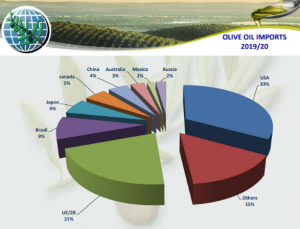
IMPORT 2020/2021

In the yellow jersey for imports is the United States with 33% of the total product imported in the 2020/21 crop year. This is followed by the EU with 21%, Brazil with 9%, Japan with 6%, Canada with 5%, China with 4%, and Australia with 3%, Mexico and Russia with 2%, and other countries with 15%.


PRICES

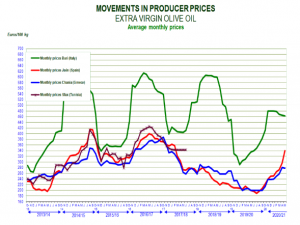
Prices also fell in the first part of the crop year, ranging from €480/100kg in Bari (Italy) to €200 in Chania (Greece).


For more information, click on the link below:https://www.internationaloliveoil.org/what-we-do/economic-affairs-promotion-unit/#prices


Campagne 2020/21 : la production en baisse mais la consommation est stable

À partir des estimations du COI, lumières et ombres d’une campagne qui marque la reprise après la pandémie mondiale. Consommation stable, production en baisse. La tendance des prix reflète les oscillations entre l’offre et la demande.

Madrid, 5 juillet 2021 – Selon les estimations du Conseil oléicole international, bien qu’avec des données provisoires, la production mondiale de campagne 2020/21 atteindrait 3.034.000 t, soit une baisse de 6,9% par rapport à la campagne précédente. La consommation, en revanche, se situerait autour de 3.211.000 t (- 0,2%). Les importations atteindraient 1.074.000 t (- 9,3%), alors que les exportations diminueraient de 8,8% par rapport à la campagne précédente, à 1.132.000 t.

En tête de la pole position en matière de production lors de la campagne 2020/21, se trouvent les pays membres de l’Accord international de 2015 sur l’huile d’olive et les olives de table du COI, qui produiraient à eux seuls 2.834.000 t, soit 93,4% du total mondial. La production du groupe des pays européens se situerait à 2.057.000 t, en hausse de 7% par rapport à la campagne précédente. Le groupe européen est mené par l’Espagne, qui enregistrerait une augmentation de 24,4%, avec une production estimée à 1.400.000 t ; suivie de l’Italie, avec 270.000 t (- 26,2%) ; de la Grèce, avec 270.000 t (- 1,8 %) ; et du Portugal, avec 100.000 t (- 28,8 %).

La production des autres pays membres du COI devrait atteindre 777.000 t (- 32,4%). En Tunisie, la production serait d’environ 140.000 t (- 68,2%), en Turquie de 210.000 t (- 8,7%), au Maroc de 160.000 t (+ 10,3%) et en Algérie de 90.000 t (- 28,7%).

On s’attend à ce que 200.000 t supplémentaires proviennent de pays qui ne sont pas membres du Conseil oléicole international, notamment de Syrie, d’Australie et du Chili.

IMPORTATIONS 2020/21 – Les États-Unis portent le maillot jaune des importations, contribuant à 33% du total des produits importés au cours de la campagne 2020/21, avant l’UE (21%), le Brésil avec 9%, le Japon avec 6%, le Canada avec 5%, la Chine avec 4%, l’Australie avec 3%, le Mexique et la Russie avec 2%. Les autres pays contribuent aux 15% restants.

PRIX – Les prix, qui ont également baissé durant la première partie de la campagne oléicole, se situent entre 200 €/100 kg à La Canée (Grèce) et 480 € à Bari (Italie).

Pour plus d’informations :

https://www.internationaloliveoil.org/what-we-do/economic-affairs-promotion-unit/#prices


Enviar noticiaShare Enlace a facebook Enlace a twitter Enlace a linkedin
Last Posts
IOC and UPM sign MoU
MADRID, SPAIN / 16.03.2026

The International Olive Council (IOC) and the Polytechnic University of Madrid (UPM) in Spain have signed a Memorandum of Understanding (MoU) to strengthen cooperation in the olive sector. The agreement was signed by Mr...

Info

Esta semana en el OHIS
MADRID, ESPAÑA / 13.03.2026

Esta semana en el sitio web del Olive Health Information Service La newsletter de la Universidad de Navarra y el COI dedicada a la salud Artículo 1 Estudios recientes han examinado el papel de los patrones alimentarios...

Info

Día Europeo para la Prevención del Riesgo Cardiovascular
MADRID, ESPAÑA / 13.03.2026

El aceite de oliva, un aliado en la prevención cardiovascular En el marco del Día Europeo para la Prevención del Riesgo Cardiovascular, el Consejo Oleícola Internacional (COI) reitera la importancia de prevenir las...

Info

International olive council logo
Privacy Policy
Somos sociales
  • Linkedin icon
  • Twitter icon
© International Olive Council, 2026
Gestionar consentimiento de cookies
Para proporcionar las mejores experiencias, utilizamos tecnologías como las cookies para almacenar y/o acceder a la información del dispositivo. Consentir estas tecnologías nos permitirá procesar datos como el comportamiento de navegación o IDs únicos en este sitio. No consentir o retirar el consentimiento, puede afectar negativamente a ciertas características y funciones.
Funcional Siempre activo
El almacenamiento o acceso técnico es estrictamente necesario para el fin legítimo de permitir el uso de un servicio específico solicitado explícitamente por el abonado o usuario, o con el único fin de llevar a cabo la transmisión de una comunicación a través de una red de comunicaciones electrónicas.
Preferencias
El almacenamiento o acceso técnico es necesario para el fin legítimo de almacenar preferencias no solicitadas por el abonado o usuario.
Estadísticas
El almacenamiento o acceso técnico que se utiliza exclusivamente con fines estadísticos. El almacenamiento o acceso técnico que se utiliza exclusivamente con fines estadísticos anónimos. Sin una citación judicial, el cumplimiento voluntario por parte de su proveedor de servicios de Internet o registros adicionales de un tercero, la información almacenada o recuperada únicamente con este fin no puede utilizarse normalmente para identificarle.
Marketing
El almacenamiento o acceso técnico es necesario para crear perfiles de usuario para enviar publicidad, o para seguir al usuario en un sitio web o en varios sitios web con fines de marketing similares.
Administrar opciones Gestionar los servicios Gestionar {vendor_count} proveedores Leer más sobre estos propósitos
Ver preferencias
{title} {title} {title}

Culinary

Olive Oil and the Plant-Forward Kitchen

Discover how the Mediterranean Diet inspires contemporary cooking.

Explore this collaboration between the International Olive Council and The Culinary Institute of America, designed to promote healthy, sustainable and flavourful food choices, with a strong focus on technical training and menu innovation for chefs.

External link

COI logo
CIA logo

Salud

El COI y la Universidad de Navarra, a través de OHIS (Olive Health Information System), una plataforma dedicada a la investigación sobre las propiedades saludables del aceite de oliva y las aceitunas de mesa, publican semanal o quincenalmente una recopilación de artículos científicos y un resumen de las investigaciones realizadas en este ámbito.

Estos artículos ponen de relieve los numerosos beneficios para la salud de estos productos.

Puede leer los resúmenes de estas investigaciones aquí en francés, inglés y español y acceder a la lista de artículos, o visitar el portal de OHIS.

Summaries OHIS portal

Para cualquier asistencia, póngase en contacto con iooc@internationaloliveoil.org.

Sustainability in the Olive Sector

Access the sustainability portal developed in collaboration between the IOC, the University of Jaén and the Instituto Universitario de Investigación en Olivar y Aceites de Oliva.

Explore research, tools and knowledge supporting sustainable olive growing and responsible production practices.

External link

X