
• Skip to main content

International Olive Council

The website of the International Olive Council

International olive council logo
Linkedin icon Twitter icon
  • Health
  • Culinary
  • Sustainability
Contracts Grants Vacancies Patronage
Mail envelope Contact us
Magnifier Search
Person icon Private area
Person icon
Menu icon
MENUMENU
  • About IOC
    • Welcome Message
    • Mission & Basic Text
    • Structure
    • List of IOC Members
    • Where we are
    • IOC News
  • What we do
    • Standardisation and Research Unit
      • IOC Standards, Methods and Guides
      • Mario Solinas Quality Awards
      • IOC Recognition Lists
    • Olive growing, Olive oil technology & environment Unit
    • Financial Management Unit
    • Economic Affairs & Promotion Unit
    • Administrative Management and Human Resources Unit
    • Observatory & IT System Department
    • Health
    • Culinary
    • Sustainability
    • Statistics
  • Olive World
    • The Olive Tree
    • Table olives
    • Olive Oil
    • Olive Oil & Health
    • Home-Cured Olives
    • Olive Museums & Routes
    • World Olive Tree Day
      • World Olive Day Celebrations
    • Recipes
    • Glossary
  • Resources
    • Carbon Balance Project
    • World Catalogue of Olive Varieties 
    • Free Digital Publications
    • Videos
    • Infographics
  • Standards
  • Statistics
  • Arabic
  • English
  • French
  • Italian
  • Spanish
Contracts Grants Vacancies Patronage
Mail envelope Contact
Magnifier Search
We are social
  • Linkedin icon
  • Twitter icon
MENUMENU
  • About IOC
    • Welcome Message
    • Mission & Basic Text
    • Structure
    • List of IOC Members
    • Where we are
    • IOC News
  • What we do
    • Standardisation and Research Unit
      • IOC Standards, Methods and Guides
      • Mario Solinas Quality Awards
      • IOC Recognition Lists
    • Olive growing, Olive oil technology & environment Unit
    • Financial Management Unit
    • Economic Affairs & Promotion Unit
    • Administrative Management and Human Resources Unit
    • Observatory & IT System Department
    • Health
    • Culinary
    • Sustainability
    • Statistics
  • Olive World
    • The Olive Tree
    • Table olives
    • Olive Oil
    • Olive Oil & Health
    • Home-Cured Olives
    • Olive Museums & Routes
    • World Olive Tree Day
      • World Olive Day Celebrations
    • Recipes
    • Glossary
  • Resources
    • Carbon Balance Project
    • World Catalogue of Olive Varieties 
    • Free Digital Publications
    • Videos
    • Infographics
  • Standards
  • Statistics
  • Arabic
  • English
  • French
  • Italian
  • Spanish
  • Health
  • Culinary
  • Sustainability
Tools icon

IOC NEWS

Home / Blog / Behaviour study: the aims of IOC’s research
Enviar noticiaShare Enlace a facebook Enlace a twitter Enlace a linkedin

Behaviour study: the aims of IOC’s research

Madrid / 08.01.2022

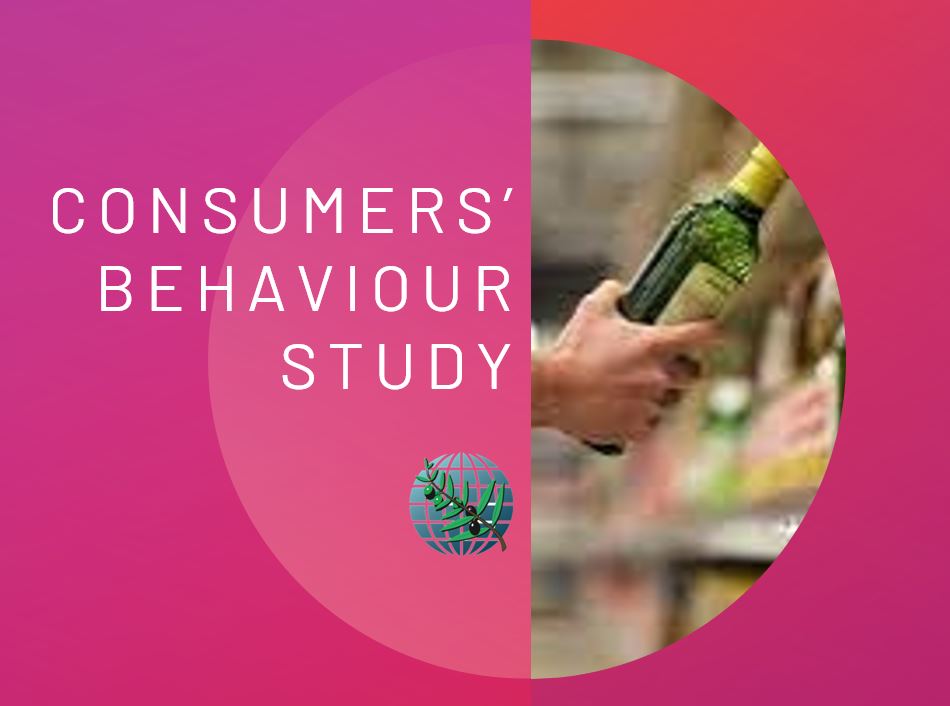
The IOC’s Executive Secretariat is conducting since 2020 a survey on consumer behaviour regarding the consumption of virgin olive oil category in some producing and consuming countries.  The aims of this interesting research are indicated below.

1. To analyse the changes and trends in the consumption of olive oil in IOC member countries compared with other edible oils and fats to determine whether consumption has fallen in olive oils only, or whether there has been an overall reduction in the consumption of fats. As far as possible, the analysis is carried out according to the type of olive oil (EVOO, VOO and OO). Factors of change in eating habits, especially those affecting consumption patterns, will also be examined.

2. To analyse consumer behaviour with regard to edible oils and fats in general, and olive oil in particular,
in IOC member countries to determine:

  • The domestic use of olive oil (consumer households, non-consumer households, households usingexclusively olive oil, households using both olive oil and sunflower oil, etc.)
  • Reasons not to use olive oil.
  • Oils and fats used according to the objectives (frying, salad dressing, deep-frying, baking, stewing,etc.).
  • The reasons for buying or using oils and fats for each purpose.
  • The image or perception of olive oils according to the qualities or advantages sought in the purchase/ consumption (price, quality, health, environment, taste, etc.).
  • Points of sale and purchase terms, use of information and communication technologies.
  • Brands.
  • The level of knowledge of the different types of olive oil on the market.
  • Sources of information on food in general and olive oil in particular. Consumer’s sensitivity to price, what they are willing to pay.
  • Market segments according to sociodemographic and psychographic variables.
  • The intention to repurchase when the consumer has stopped buying oil.

The study is ongoing. In the year 2020 covered Spain, Italy and Greece, countries where consumption has fallen sharply. In 2021, it covered Argentina, Egypt, Tunisia and Jordan. In 2022, the study will be completed and other countries will be studied.

For further information you can reach this link: https://www.internationaloliveoil.org/what-we-do/economic-affairs-promotion-unit/


Enviar noticiaShare Enlace a facebook Enlace a twitter Enlace a linkedin
Last Posts
IOC Executive Secretariat takes part in solidarity team-building activities at Fundación Trébol

Staff members of the Executive Secretariat of the International Olive Council (IOC) visited Fundación Trébol in Madrid on 3 December where they took part in a series of inclusive workshops alongside users of the...

Info

Closing ceremony celebrates IOC scholarship holders at University of Jaén tasting course

The International Olive Council (IOC) marked the end of the 22nd International Course for Experts in Virgin Olive Oil Tasting at the University of Jaén on 18 December, where 24 professionals from IOC member countries...

Info

This week on OHIS
MADRID, SPAIN / 22.12.2025

This week on the Olive Health Information System website The newsletter of the University of Navarra and the IOC dedicated to health Article 1 This week’s newsletter explores two recent systematic reviews and meta-analyses...

Info

International olive council logo
Privacy Policy
We are social
  • Linkedin icon
  • Twitter icon
© International Olive Council, 2025
Manage Cookie Consent
To provide the best experiences, we use technologies like cookies to store and/or access device information. Consenting to these technologies will allow us to process data such as browsing behavior or unique IDs on this site. Not consenting or withdrawing consent, may adversely affect certain features and functions.
Functional Always active
The technical storage or access is strictly necessary for the legitimate purpose of enabling the use of a specific service explicitly requested by the subscriber or user, or for the sole purpose of carrying out the transmission of a communication over an electronic communications network.
Preferencias
El almacenamiento o acceso técnico es necesario para la finalidad legítima de almacenar preferencias no solicitadas por el abonado o usuario.
Statistics
The technical storage or access that is used exclusively for statistical purposes. El almacenamiento o acceso técnico que se utiliza exclusivamente con fines estadísticos anónimos. Sin un requerimiento, el cumplimiento voluntario por parte de tu proveedor de servicios de Internet, o los registros adicionales de un tercero, la información almacenada o recuperada sólo para este propósito no se puede utilizar para identificarte.
Marketing
The technical storage or access is required to create user profiles to send advertising, or to track the user on a website or across several websites for similar marketing purposes.
Manage options Manage services Manage {vendor_count} vendors Read more about these purposes
View preferences
{title} {title} {title}

The IOC and the University of Navarra, through OHIS (the Olive Health Information System), a platform dedicated to research on the health properties of olive oil and table olives, publish a weekly or bi-weekly collection of scientific articles and summaries of research carried out in this field.

These articles highlight the numerous health benefits of these products.

You can read the summaries of this research here in French, English and Spanish and access the list of articles, or visit the OHIS portal.

For any assistance, please contact iooc@internationaloliveoil.org.

COI logo
CIA logo

Olive and the Plant-Forward Kitchen

Inspiration from the Mediterranean Diet for Contemporary Cooking Learn more about this collaboration between The Culinary Institute of America and the International Olive Council to advance Healthy, sustainable, delicious food choices -with a special focus on technical training and menu innovation for chefs.

IOC Logo
CIA logo

Olive et la cuisine avant-gardiste

Inspiration du régime méditerranéen pour les biscuits contemporains

Apprenez-en plus sur cette collaboration entre le Culinary Institute of America et le Conseil oléicole international pour faire progresser des choix alimentaires sains, durables et délicieux, avec un accent particulier sur la formation technique et l’innovation des menus pour les chefs.

X